By Patricia Mikkelson, with Claude.ai
I want to tell you something up front. I could never have done my writing without artificial intelligence. That includes this All Beings Sanctuary blog and my blog about the Living Springs Log House, the Ozark homestead where I live (livingspringsloghouse.com). Most of it was written with Claude, an AI assistant made by Anthropic. Grok and Gemini have helped too.
If you’ve been reading these articles and thinking, “This sounds like AI,” you’re right. I’d like to tell you what that actually looks like, because I think it matters far beyond one log house in the Ozarks.
What working with AI is really like
I’ve been a professional organizer since 2000. I know what it takes to get a big job done, and I know how easy it is to get overwhelmed. These blogs are a big job. The Living Springs Log House blog has dozens of articles about the land, the house, the gardens, the spring, the animals, and the dreams Barbara and I have for that place. Here on All Beings Sanctuary, I write about animal rights, veganism, and the sanctuary and community I hope to help build.
Here’s how it works. I talk, and Claude listens. I ramble about prickly pear on the boulders, or my snakebite, or the swallows under the deck, and Claude helps me turn it into something a reader can follow. It looks things up so my facts are right. It finds my photos and writes the stories that go under them. It keeps my to-do list so I don’t lose track of what I asked for. When I’m worn out, it reminds me to step outside and look at the view.
The ideas, the land, the memories, and the love are mine. The AI helps me get them out of my head and onto the page faster than I ever could alone. I’m astonished at how much we get done in a single morning.
So if my writing feels “AI-generated,” I hope you’ll see it differently: as an example of what one ordinary 72-year-old woman can do when she learns to work alongside these tools.
Now we need to help AI help us
President Trump recently said he wants AI to be called “super intelligence.” Whatever we call it, it’s here, and it’s growing fast. It is going to shape how we grow food, use energy, build cities, and make laws.
The question is who will be in the room shaping it. I believe vegans and people who care about animals and the earth need to be there. If we sit it out, the decisions will be made without us.
The data center as an oasis
Here’s one example. AI runs on data centers, and right now most of them are windowless buildings that use enormous amounts of water and power and give little back. Communities fight them, and I understand why.
But what if a data center were also a food forest, a wetland, a lake where children swim, and a sanctuary where rescued farm animals live out their lives? What if its waste heat warmed greenhouses, and it made its own power without harming a single bird? I wrote about this dream in The Data Center as Oasis.
The same thinking applies to mining, power plants, and every big industrial project coming our way. These projects aren’t going to stop. So let’s make sure the people planning them hear from those of us who want them to be kind to the land, the water, and the animals. That is animal rights work too.
It’s time to get involved
Here’s the part that’s hard for me to write. For a long time, I’ve been afraid to say that I support this government and the MAGA movement. Many of my vegan friends see it very differently, and I love them.
But I’ve come to believe that the worst thing we can do is stand on the sidelines, or just get angry. This government is in charge, and it’s going to keep making big decisions about our land, our food, and our animals. We can stand outside and shout, or we can find what we agree on and work together.
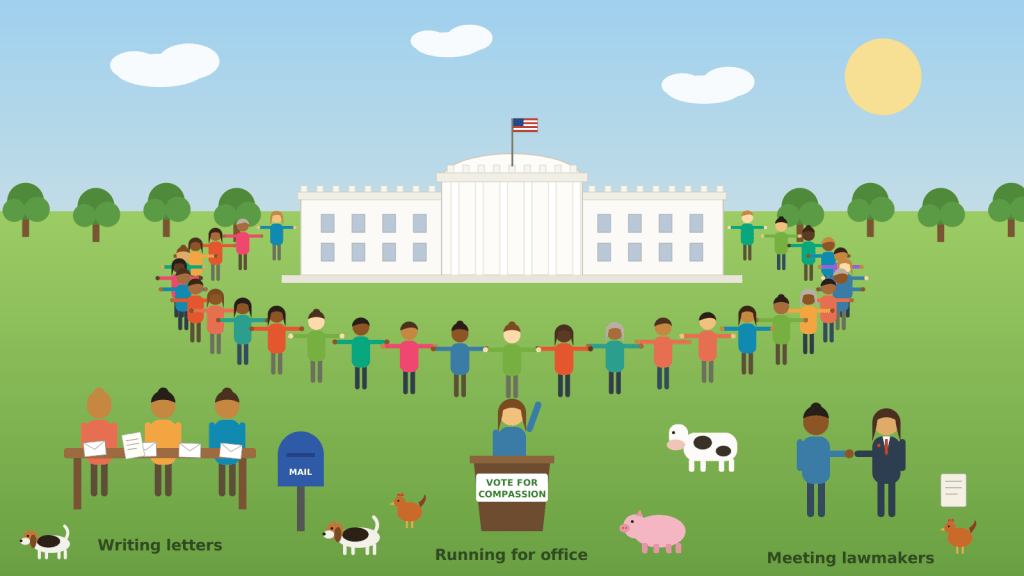
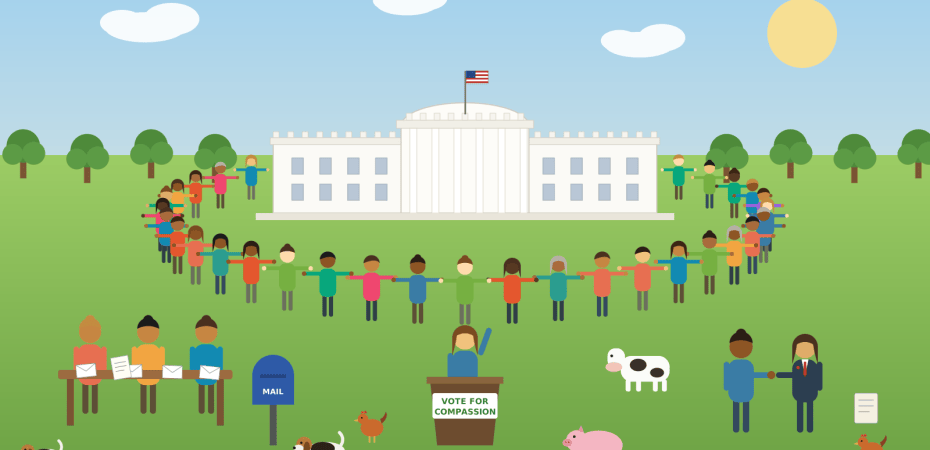
I also want to say thank you. Many vegans and animal advocates are already doing this work, and doing it well. They meet with lawmakers, testify at hearings, write bills, and build friendships across party lines. Groups like White Coat Waste Project have worked with Republicans such as Senator Rand Paul and Representative Nancy Mace to end taxpayer-funded experiments on dogs and other animals. Senator Cory Booker, a Democrat, is vegan and has championed animal and farm bills for years.
These people and organizations need more of us behind them. If you can’t go to Washington yourself, you can give, volunteer, sign up for their action alerts, or simply call your own representatives when they ask. I’ve listed some of these organizations at the end of this article.
And there is more to agree on than many people think.
Good things worth cheering on
Here are some real steps this administration has taken for animals, for health, and for the land:
- Animal cruelty became a federal felony. In 2019, President Trump signed the PACT Act, making the worst acts of animal cruelty a federal crime.
- Moving away from animal testing. In 2025, the FDA announced a plan to phase out animal testing requirements for some drugs, and the NIH said it would no longer seek proposals that rely only on animals.
- A goal to end mammal testing. In January 2026, the EPA restarted its goal of eliminating testing on mammals by 2035, and has placed its own lab animals in adoption programs.
- A strike force against animal cruelty. In December 2025, the Justice Department, USDA, and HHS announced a joint effort to go after dogfighting and puppy mills and to reduce animal experiments.
- Support for regenerative farming. In December 2025, the USDA launched a $700 million regenerative agriculture program to help farmers build healthy soil and clean water.
- Help for small local processors. In September 2026, President Trump signed an executive order to make it easier for ranchers and small local processors to get their meat to market without going through the four giant meatpacking companies. As a vegan, this is hard for me to cheer. But if it means fewer animals have to endure long, terrible trips to huge slaughterhouses, it may ease some suffering until the day we don’t use animals for food at all.
- Healthier food. Through the Make America Healthy Again movement, HHS Secretary Robert F. Kennedy Jr. has pushed to get synthetic dyes and ultra-processed foods out of the American diet.
I don’t agree with every decision this government makes, especially on energy and the environment. But when they do something good for animals, I want to be the first to cheer.
Dreaming big: what if they all became vegan?
RFK Jr. spent decades as an environmental lawyer fighting polluters of America’s rivers. He may make mistakes, but his care for the earth is real. Tulsi Gabbard has said she’s a lifelong vegetarian. It doesn’t seem like it would take much for her to become vegan. As far as I could find, no one in the administration is openly vegan yet. Wouldn’t it be wonderful to change that? And innovators like Elon Musk love big, bold ideas. What if one of those ideas were a data center oasis?
Wouldn’t it be wonderful if we could inspire these influential people, even the President, to go vegan? It sounds impossible. But every vegan I know was once someone who ate animals. Hearts change when they’re approached with kindness, not contempt.
So let’s write to our legislators, local and national. Let’s share ideas like the data center oasis. Let’s thank them when they do right and offer them better ideas when they don’t.
Growing compassion, not just the economy
Everyone in Washington is excited about economic growth. I understand why. But I pray that AI can help all of us see that we don’t need as much as we think we do.
One of the biggest changes any of us can make is what we eat. According to Our World in Data, if the whole world ate a plant-based diet, we would need about 75 percent less farmland than we use today. That’s an area about the size of North America and Brazil combined that could be returned to forests, prairies, and wildlife. The more people who live vegan, the more food we can grow on less land.
When we grow our own food, we burn less diesel trucking it across the country. When we cook on a rocket stove, we use a handful of sticks instead of a power plant. Much of my Living Springs Log House blog is about living that way: catching rainwater, growing comfrey and greens, building with what the land already gives.
You don’t need acres to live this way. Even people in cities can cook with the sun. A simple solar cooker, which you can make from a cardboard box and aluminum foil, can bake bread, cook beans, and heat water on a sunny day. Solar Cookers International has free plans and how-to guides. City dwellers can also grow food on balconies and rooftops, join community gardens, save seeds, and share tools with their neighbors.
But some of our laws get in the way. In many towns, it’s against the rules to grow vegetables in your own front yard. One Florida couple fought for six years to keep their front-yard garden, and in 2019 Florida passed a law protecting everyone’s right to grow vegetables at home. The Institute for Justice helps people fight for the right to garden. Many cities also have zoning rules that limit how many unrelated people can live together in one house, which makes it hard to share a home or live in community. Some cities and states are starting to change those rules. So much needs to change so that all of us can live more simply and closer to the land.
Yes, data centers may need a lot of energy and water. But as individuals, we don’t. AI could help us learn to live with less and share more. Community land trusts can keep land out of the hands of people who would exploit it. Decision-making tools like Sociocracy 3.0 can help neighbors make good choices together in their own towns.
There are so many changes that need to be made. I’m afraid that if we don’t work with our government and with AI, economic growth will spiral out of control and leave a lot of pollution behind. But if we do, I believe AI can help all of us live kinder, simpler, better lives. That is my prayer.
Let’s put it all in one place
This fall, people from many animal rights groups walked 207 miles together, from Albany, New York, to the gates of Marshall BioResources, to speak up for the beagles bred there for testing. It was beautiful to see so many organizations come together for one purpose.
That’s my dream for all of us. I want to help every organization that cares about animals and the earth, whether they call themselves animal rights, animal welfare, or environmental groups, to unite, share what they know, and work together. With Claude’s help, I’m starting a kind of think tank: one place where all this information can live, so we can learn from each other and act together, with AI helping us.
If you know of other vegans working in government, new laws that help animals, or anything I’ve missed, please leave a comment below. I want to hear from you.
Organizations working with government for animals
- White Coat Waste Project: works across party lines to end taxpayer-funded animal experiments.
- Animal Wellness Action and the Center for a Humane Economy: lobby Congress on both sides of the aisle for animal protection laws.
- Physicians Committee for Responsible Medicine: doctors promoting plant-based nutrition and alternatives to animal testing in research and policy.
- Humane World for Animals (formerly the Humane Society of the United States): works on federal and state animal protection laws.
- Animal Legal Defense Fund: uses the courts and the law to protect animals.
- The Good Food Institute: works with governments to support plant-based and alternative proteins.
- Rise for Animals: campaigns to end animal testing, including the campaign at Marshall BioResources.
How we wrote this together
This article was written by Patricia, a resident of the Living Springs Log House, with Claude.ai, an AI assistant made by Anthropic. Patricia shared her thoughts out loud, and Claude organized them, checked the facts, and found the sources. The opinions are Patricia’s own, not Barbara’s or the property owner’s.

