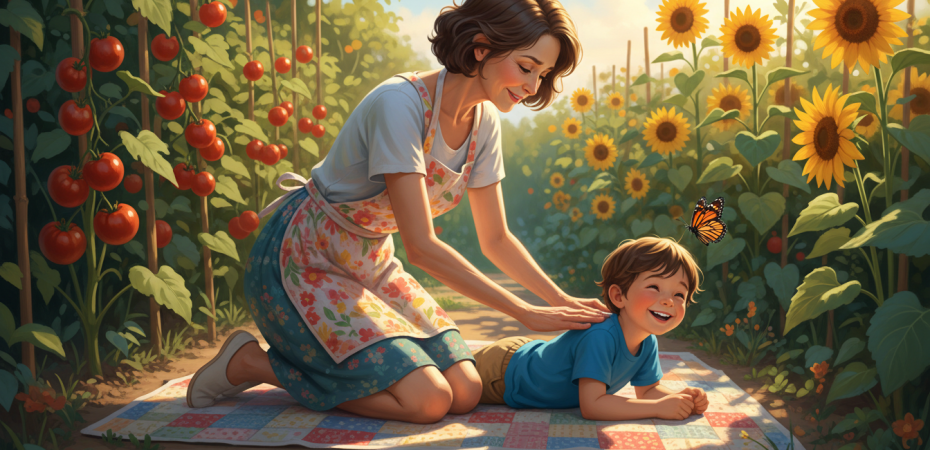
A gentle touch game from “Little Friends of All Creation,” for parents, grandparents, babysitters, aunts, uncles and anyone who loves children
“I have planted, Apollos watered; but God gave the increase.” 1 Corinthians 3:6
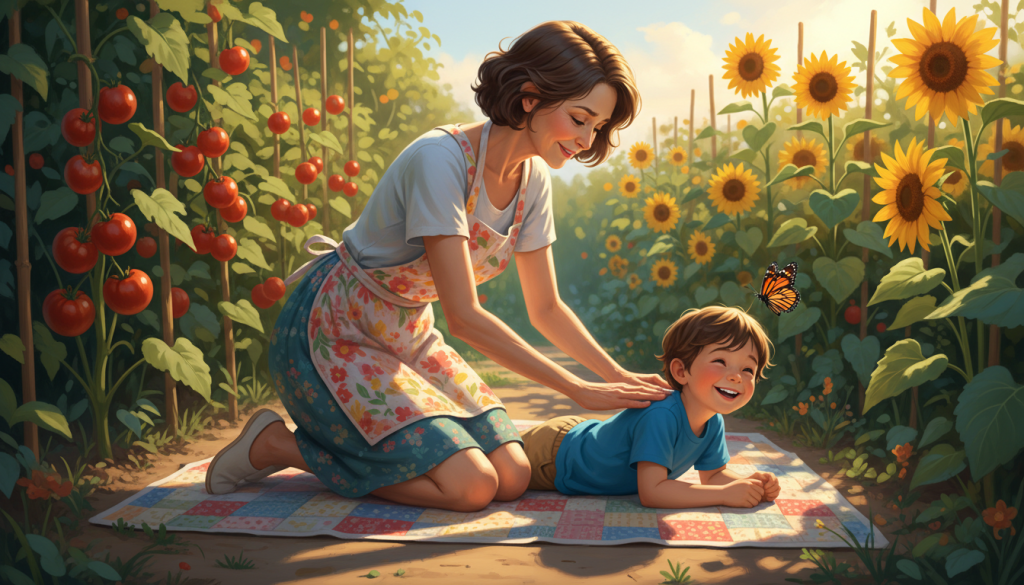
Of all the gentle touch games, this is often the one children ask for again and again. It’s part back rub, part story, and part garden lesson. Children lie still, feel cared for, and use their imagination, all at once. And when the plants “come up” at the end, they get to call out everything that grew.
Start by asking: “Would you like me to plant a garden on your back?” Most children say yes right away. Once one child has a garden, the others usually line up for theirs.
Getting Ready
- Always ask first. Let the child say yes or no. If they wiggle away partway through, let them go. Their body, their choice, just like the animals.
- Shirt on or shirt off. The game works beautifully over a T-shirt or light sweater, anywhere at all. At home, if a child would rather go without a shirt, that’s fine too. Skin-on-skin touch feels warm and soothing. A little coconut oil, olive oil or plant-based lotion helps your hands glide.
- Sitting or lying down, whichever they like. The child can lie on their tummy on the couch, a bed, or a blanket on the floor, or sit on a stool or on the floor with their back to you.
- Babysitters and family friends: check with the parents before you play, and keep shirts on.
- Warm hands. Rub your palms together first. Cold hands make a garden shiver!
- Short nails, no rings. Rings and long nails can scratch.
How to Touch Gently
Children’s bodies are small, and their skin and muscles are tender. Here’s how to keep it feeling good:
- Let the child choose the pressure. Ask, “Do you want bunny pressure, kitty pressure, or bear pressure?” Bunny is light as a feather, kitty is medium, and bear is a firm, cozy press. Most children love kitty pressure, and many little ones want bunny.
- Stay beside the backbone, not on it. Imagine the spine as the garden path. You plant on both sides of the path, but you don’t stomp on it.
- Be extra light on the neck and the lower back. The shoulders and the wide upper back can take a little more pressure.
- Watch their face and listen. Giggles and sleepy sighs mean it’s going well. A squirm or “ow” means lighter or stop.
- Go slowly. Slow movements calm the body. Fast movements make children giggly and wiggly, which is fine too, but save those for the playful parts.
- Use your whole hand for pressing and smoothing, and just your fingertips for tapping and poking.
Let’s Plant a Garden!
Say each line in a storyteller’s voice, then do the motion. Pause between steps so the child can feel each one.
1. Let’s look at our garden spot.
Walk your fingers slowly all over the back, like a gardener walking around the yard. “Hmm, this looks like a good sunny place for a garden!”
2. Pull out a few weeds.
Make little gentle pinches and tugs on the shirt, and soft squeezes on the tops of the shoulders. “Oh, here’s a big weed! Pull! And here’s a little one. Pull!” Go all over the back, wherever the weeds are hiding.
3. Lay the cardboard blanket.
Place both flat hands on the back and slide them slowly from the shoulders down to the waist, pressing gently, as if smoothing a big sheet of cardboard. “We don’t need to dig. We just lay down cardboard to tuck the weeds in for a long sleep.”
4. Spread the good compost.
With flat palms, make slow, round circles all over the back, like spreading rich, crumbly soil. For bigger children who like kitty or bear pressure, gently knead the shoulders like bread dough. “This is the good stuff. Leaves and old plants turned into food for the garden.”
5. Here come the earthworms!
Wiggle your fingers in little squiggly lines up and down the back. “The worms are moving in to make the soil soft and good. Thank you, worms!” (This one usually brings giggles.)
6. Rake it smooth.
Spread your fingers like a rake and draw them slowly down the back, again and again. “Rake, rake, rake. Nice and smooth.”
7. Plant the seeds.
Poke gently with one fingertip in rows down each side of the back. Name the seeds as you go: “Here’s a tomato seed. Here’s a pepper. Here’s a bean, and another bean, and another bean. Here’s a big pumpkin seed!” Let the child tell you what else to plant.
8. Cover the seeds and tuck them in.
Gently press your palm over each row, as if patting the soil down over the seeds. “Tuck, tuck, tuck. Sleep tight, little seeds.”
9. Put on the mulch.
For straw mulch, make long, slow sweeping strokes. For leaf mulch, flutter your fingers lightly all over, like leaves falling. “Now a cozy blanket of straw to keep the seeds snug and the soil damp.”
10. Here comes the rain!
Pitter-patter with all your fingertips, very lightly at first, then a little harder for a big rainstorm, then slowing to just a few drops. “Drip… drip… drip, drip, drip… Here comes a big rain! Now it’s slowing down… just a few more drops.”
11. Out comes the sun.
Rub your palms together to make them warm, then rest both hands flat on the back for a moment. Then make big, slow circles. “Ahh, the warm sun is shining on the garden.”
12. Look! The plants are coming up!
Walk your fingers slowly up from the waist toward the shoulders on both sides of the spine, like little sprouts pushing up. “Oh, look! Something’s poking up! What is it?” Let the child shout out what grew: tomatoes, peppers, carrots, strawberries, sunflowers, watermelons! Get excited about every single one.
13. Visitors come to the garden.
Touch lightly here and there with a fingertip, like a bee landing on a flower, or flutter two fingers like butterfly wings. “Bzzz. The bees are visiting the flowers so we get lots of fruit.” Then hop two fingers across the back. “And here comes a little bunny! Hop, hop, hop. Let’s leave a few carrots for the bunny. In our garden, there’s enough for everyone.”
14. Time to pick!
Make gentle little squeezes all over the back, “picking” each thing the child named. “Here’s a big red tomato. Here’s a pepper. Here’s the biggest pumpkin I ever saw!”
15. Thank you, God, for the garden.
Finish with three long, slow strokes from shoulders to waist, then a hug if the child wants one. “Thank you, God, for the rain and the sun and the seeds and the worms. Amen.”
The Whole Garden: A Full-Body Version
When a child is loving the back garden, keep going! Have them roll over onto their back, or sit facing you, and grow the rest of the garden. Gentle squeezes on arms and legs feel wonderful and help children feel safe and settled. Use kitty pressure, squeeze the soft muscles rather than the joints, and keep the neck and face extra light.
The fence posts (shoulders). Rest your hands on both shoulders and give slow, gentle squeezes. “Let’s check the fence posts. Nice and strong!”
The bean vines (arms). Hold one arm with both hands and squeeze gently from the shoulder down to the wrist, a little at a time. “The bean vines are climbing all the way down! Squeeze, squeeze, squeeze.” Do the other arm.
Picking the beans (fingers). Hold each finger and slide gently to the tip with a tiny “pop.” Name each one: “Green bean! Snap pea! Strawberry! Cherry tomato! Blueberry!”
The sunflower faces (hands). Press slow circles into the palm with your thumbs. “This sunflower is turning to look at the sun.”
The cornstalks (legs). Squeeze gently from the top of the leg down to the ankle, like your hands are climbing down a tall cornstalk. Then hold the foot and give a soft little wiggle. “Shake the cornstalk! Did any corn fall down?”
Digging the potatoes (feet and toes). Press the bottom of the foot with your thumbs, then wiggle each toe. “Let’s dig for potatoes. One potato, two potato, three potato, four… five potatoes!” (Some children are very ticklish here. Go firmer or skip it.)
Sunshine on the garden (tummy, only if the child likes it). Rub your hands warm and rest one flat hand on the tummy, then make slow circles. “The sun is warming the whole garden.”
Rain soaking in (head). With your fingertips, make slow little circles all over the head, like shampooing. “The rain is soaking deep into the soil.” Then smooth the forehead lightly from the middle out to the sides. “And now the soil is smooth and soft.”
The big harvest hug. Finish with a big squeezy hug, or tuck the child in under a blanket. “We picked the whole garden! Now let’s tuck it in under a blanket of mulch for a rest.”
Ways to Change It Up
- The old-fashioned digging garden. Some children love the digging! Instead of the cardboard, compost and worms, “dig the soil” with firm kneading on the shoulders and upper back, “break up the clods” with gentle knuckle circles, and “turn over the dirt” with deeper palm circles.
- Turn it around. Now let the child plant a garden on your back. Children love being the gardener, and it teaches them gentle hands.
- The garden train. With several children, sit in a line, each one facing the next one’s back. The grown-up calls out each step, and everyone plants a garden at the same time. The child at the front can plant on a stuffed animal.
- Seasons garden. In fall, rake up the leaves and plant garlic for next year. In winter, let the snow fall softly (light fingertip touches) and the garden sleep under a white blanket. In spring, plant peas first!
- Bedtime garden. Do everything very slowly and softly, and let the garden “fall asleep” at the end. Wonderful before naps.
- Name the garden. Ask, “What kind of garden should we plant today?” A salad garden, a pizza garden (tomatoes, peppers, onions, basil), a rainbow garden, or a garden just for the bunnies and the birds.
Why It Helps
- Calm bodies. Slow, warm touch helps a child’s body settle down. It’s a lovely game after big movement or before a story.
- Love and trust. Children feel cared for when a grown-up gives them unhurried, loving touch.
- Body awareness. Feeling different kinds of touch (taps, strokes, presses, wiggles, squeezes) helps children notice their own bodies.
- Memory and order. Children quickly learn the steps and often tell you what comes next. “Now it’s the rain!”
- Where food comes from. They learn that good food grows from tiny seeds and needs soil, worms, rain, sun and bees, all made by God, and that a garden can feed people and leave plenty for the bunnies and birds too.
- Words. Naming vegetables, fruits and flowers grows a child’s vocabulary.
“While the earth remaineth, seedtime and harvest… shall not cease.” Genesis 8:22
A note on safety: Keep pressure light for young children and avoid pressing on the spine, neck or lower back. Skip this game, or that part of the body, if a child has a sunburn, rash, injury or sore spot, and stop anytime a child asks.
This chapter was written together with Claude. The garden game, the no-dig steps, the full-body squeezes and the joy of hearing children call out everything that grew all come from Patricia’s own time with her grandchildren. Claude helped write it up and add the gentle-touch tips and new versions.

