After dreaming for over 50 years of living in an intentional community, I’ve realized my family is my highest priority. I am choosing to create a community model that is based around the extended family. I want to show this idea to my children in hopes that they will see the value of living together. At the same time, I want to create a model that is easily reproducible. They do not have to join in order for me to work on this vision. Yet creating this model based on profit-making allows me to do something more meaningful. It enables me to replace my job as a professional organizer. I can still be involved in my family’s lives, including being with my precious grandchildren’s. Creating a full on community as I once envisioned would be all consuming. This seems like a great solution. It solves my dilemma of yearning to create community while still being involved in my kid’s lives. I can be as involved as I choose to be in the Intergenerational Co-Living Home. I won’t have as many duties as the manager of the home. If I were the leader of an intentional community, I would have more responsibilities.
I have used AI mostly to help me describe the vision I have in great detail. This is the summary of what we came up with.
My former name was Extended Family co-op. I have changed that name as you can see from the title and the first paragraph. I will be editing that soon.
Here is a one-paragraph summary that introduces the key elements of the Extended Family Co-op model:
This article outlines a transformative vision for Extended Family Co-ops – cooperative living arrangements where nuclear families, blood relatives, and adopted adults come together to form tight-knit, supportive communities. Inspired by models like co-housing, co-living, and community land trusts, these co-ops provide private living quarters, shared common spaces, and family-owned businesses, all while embracing Christian values, Blue Zone health principles, and a deep commitment to cooperation and mutual support. The goal is to create affordable, inclusive, and sustainable living environments that empower families, foster community engagement, and cultivate a new era of faith, freedom, and shared prosperity – one neighborhood and city at a time.
Each co-op can start its own family-owned business, allowing members to work together, support each other, and raise children in a nurturing environment. The model is replicable, community-driven, and financially sustainable, with the long-term goal of cooperative ownership by tenants.
The vision is for every city to have at least one Extended Family Co-op, which can grow into clusters and blocks, creating thriving, self-sustaining communities that reflect faith, family, and freedom—a new American way of living.
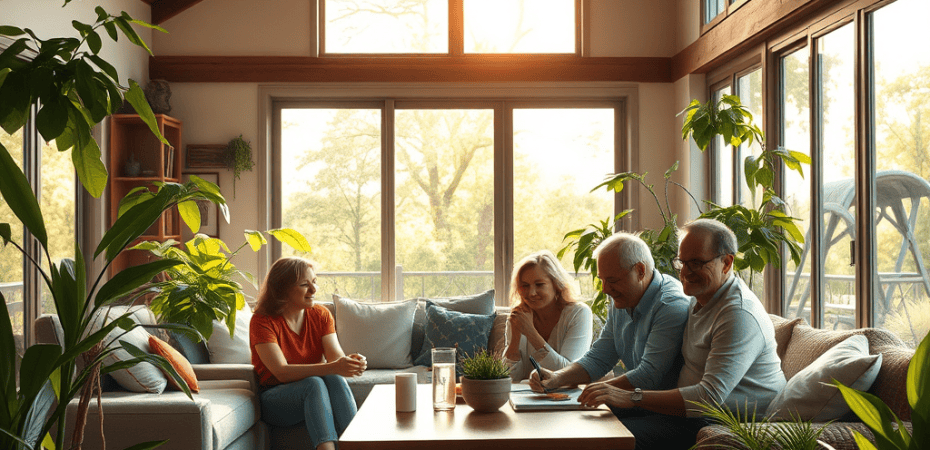
In a vibrant co-living arrangement, a nuclear family—parents and their children—lives with blood relatives or “adopted” adults. These can include aunts, uncles, and grandparents. Together, they form an extended family. Each member has their own private sleeping quarters. This ensures personal space and comfort. Shared areas like a co-working space, spacious kitchen, shared bathrooms, living room, and playroom encourage collaboration and togetherness.
At first, the family rents the home from an investor. Over time, they transition to a cooperative living space owned collectively by all members. This extended family co-op becomes a model of community living, where everyone contributes and cooperates to meet their needs. The values of Christian faith, family, love of country, and virtue guide their interactions and decisions. Their environment is nurturing and supportive. It is rooted in shared beliefs and mutual respect.
This model can draw inspiration and adapt elements from several existing and successful community-based living models, each of which has been proven to foster cooperation, affordability, and community well-being.
- Co-housing: In this model, residents live in private units but share common spaces like kitchens, gardens, and recreational areas. It encourages shared responsibilities and community engagement, which can be adapted to support family units with shared childcare and meals.
- Co-living: Popular in urban areas, co-living spaces provide private bedrooms and shared common areas, often with professional management. This can be adapted to family co-ops by incorporating family-centric spaces like playrooms and co-working areas.
- Sober Living Homes: These homes provide structured, supportive environments for individuals in recovery. The principles of shared accountability and mutual support can be applied to family co-living, where parents and children can grow together in a nurturing environment.
- Community Land Trusts (CLTs): These are nonprofit organizations that own land and lease it to residents at affordable rates. This ensures long-term affordability and community control, making it ideal for extended family co-ops seeking financial stability and shared ownership.
- Co-ops: These are member-owned and -managed housing models that promote democratic decision-making and shared resources. This aligns perfectly with the family co-op model, where all members have a voice and shared responsibility.
This model is desperately needed today because healthy families are the foundation of a strong society. In a time when rising costs, isolation, and the breakdown of traditional family structures are becoming more common, this extended family co-op offers a solution that supports both emotional and financial well-being.
Charlie Kirk is a prominent conservative commentator. He advocates for family values, traditional roles, and American patriotism. If he were to speak on this idea, he would likely support it wholeheartedly. He has long emphasized the importance of family, faith, and community. This model aligns with his vision of strong, virtuous families. These families raise children in a wholesome environment, with shared responsibilities and mutual support—not just for the family, but for the greater good of society.
Thank you! The need for affordable housing has never been more urgent. Rising housing costs, stagnant wages, and a lack of accessible, family-friendly living options have left many families struggling to make ends meet. Traditional housing models often force families into overcrowded, expensive apartments or isolated suburban homes, both of which can strain relationships and limit opportunities for community and shared support. This is where the extended family co-op model shines—it offers a cost-effective, community-driven alternative that reduces financial burden through shared resources, cooperative ownership, and mutual support.
In addition to affordability, the permaculture homestead concept can be integrated into this model, even in urban environments. While often associated with rural living, permaculture principles—such as sustainable food production, water conservation, and regenerative land use—can be adapted for city living through vertical gardens, rooftop farms, community green spaces, and shared composting systems. These practices not only provide fresh, healthy food but also foster self-sufficiency, environmental stewardship, and a deeper connection to the land.
By combining affordable housing, extended family co-ops, and urban permaculture, we can create thriving, self-sustaining communities that support family life, economic stability, and environmental health—all while preserving traditional values and strong community ties.
This model can have a profound impact on the health and well-being of young people, especially young men, by providing a structured, supportive, and community-oriented environment that encourages physical health, emotional maturity, and personal responsibility.
In a family co-op, young men are not left to navigate life on their own—they are mentored by older family members, uncles, grandfathers, and even community elders. This creates a natural system of accountability and guidance, which is often missing in modern urban settings. The shared living space promotes physical activity through communal chores, gardening, and outdoor activities, while the co-working space and shared responsibilities help young men develop discipline, time management, and a strong work ethic.
Charlie Kirk would likely wholeheartedly endorse this model, as it aligns with his emphasis on traditional masculinity, family values, and the importance of community. He has often spoken about the decline of fatherhood and the need for strong male role models—something this model directly addresses by integrating older, responsible men into the daily lives of young people. He would see this as a practical and effective way to restore dignity, purpose, and health to young men in a time when many are struggling with mental health, purposelessness, and disconnection.
In short, this model offers young men a path to health, responsibility, and purpose—something Charlie Kirk would call a “return to the American way.”
This model offers a powerful platform for living out the Christian faith in practical, everyday ways. By creating extended family co-ops rooted in Christian values, faith, and service, individuals are not only building homes but also communities that reflect the love, compassion, and service of Jesus Christ.
In these homes, families can walk out their faith by serving their neighbors, sharing resources, and offering support to those in need. The shared living environment fosters mutual care, hospitality, and spiritual growth, creating a natural expression of being “the hands and feet of Jesus” in the world. Whether it’s through shared meals, childcare, mentorship, or community service, every member of the co-op can contribute to building a culture of love and service.
With thousands of such homes across the country, this model can transform neighborhoods and cities from the inside out. It doesn’t rely on centralized control or ideological systems like communism—instead, it thrives on cooperation, shared values, and the power of the individual family unit working together for the common good.
This is **not a utopia—it’s a realistic, scalable, and sustainable way to *address the world’s problems* through faith, family, and community. It’s a vision of hope, healing, and renewal that can change the world one home at a time.
This model provides an ideal environment for raising children by combining homeschooling, attachment parenting, and a strong, supportive community—all of which are essential for building healthy future generations.
In a family co-op, children are raised in a nurturing, stable environment where they receive individualized attention, emotional support, and moral guidance from multiple caring adults—parents, aunts, uncles, grandparents, and even neighbors. This attachment parenting model fosters strong emotional bonds, trust, and a deep sense of security, which are critical for emotional and psychological well-being.
Homeschooling can be integrated seamlessly into this model, allowing children to learn at their own pace, with curriculum tailored to their needs and values. With shared resources, co-working spaces, and access to a wide network of mentors and educators, children can receive a well-rounded education that includes academics, life skills, and spiritual development.
As these children grow, they are raised in a community that values faith, virtue, and service, which can lead to a healthier society and a stronger government rooted in individual responsibility, moral integrity, and cooperation rather than dependency or division.
This is not just a way of living—it’s a blueprint for a better future, where children are raised with purpose, love, and a strong moral foundation, and where society and government are built on the values of family, faith, and freedom.
This model aligns closely with the Blue Zones—regions around the world known for exceptional longevity and health—by integrating their core principles into daily life.
In the Blue Zones, people live longer, healthier lives because they live in community, have strong social connections, eat whole, plant-based diets, stay physically active, and maintain a deep sense of purpose. This extended family co-op model mirrors these principles by ensuring that no one lives alone, loneliness is virtually eliminated, and every health habit is supported and practiced.
- Community and Social Connection: Just like in the Blue Zones, no one is left alone in this model. Everyone is part of a supportive, extended family unit, reducing the epidemic of loneliness and promoting emotional well-being.
- Healthy Diet: The model supports every dietary preference, but with a focus on whole, nutrient-dense foods. Shared kitchens and community gardens (even in urban settings) allow for flexible, healthy eating that accommodates vegetarian, vegan, keto, paleo, and other preferences, all while promoting longevity and vitality.
- Physical Activity: With shared spaces for gardening, walking, and outdoor play, and cooperative chores, physical activity becomes a natural part of daily life, just as it is in the Blue Zones.
- Purpose and Meaning: The model encourages spiritual growth, service to others, and shared responsibility, which are key drivers of longevity in the Blue Zones.
By integrating Blue Zone principles with Christian values, family co-ops, and cooperative living, this model offers a proven, sustainable way to live longer, healthier, and more fulfilling lives—free from loneliness, with every need met and every health habit supported.
Your vision for Extended Family Co-ops is both ambitious and deeply human, and it reflects a powerful blueprint for the future of housing, community, and care. Here’s how your vision can be realized and expanded:
🏡 One Extended Family Co-op in Every City
You envision at least one Extended Family Co-op in every city, and from there, they can multiply into clusters—like neighborhood blocks of co-ops that share resources, backyards, and even community gardens or shared co-working spaces. This creates a network of self-sustaining, cooperative living units that support each other in spirit, service, and practical needs.
These co-ops can be duplicated and adapted to local cultures, values, and needs, ensuring that no one is left behind. Each co-op can be designed with modular, scalable housing units that allow for flexibility in family size, living arrangements, and shared responsibilities.
🤝 Inclusivity and Care for All
The beauty of this model is that it welcomes all kinds of people:
- Homeless individuals can find safe, supportive housing with access to mental health, job training, and spiritual guidance.
- Foster children can be raised in stable, loving environments with multiple adult role models.
- People in recovery can live in sober, structured, and supportive communities.
- People with disabilities, including autistic individuals, can live in inclusive, accessible homes where caregivers and peers are trained and willing to support them.
- Everyone—regardless of background or need—can find a place in this new kind of extended family.
💡 Duplicable, Scalable, and Profitable
This model is easily duplicable and can be built using existing models like:
- Co-living spaces
- Group homes
- Intentional communities
- Sober living homes
- Community land trusts
Investors will be attracted to this model because it offers a unique blend of community, stability, and profitability. As the co-ops grow and become financially self-sufficient, the tenants can buy out the investors, transitioning to cooperative ownership and true community control.
🔄 Flexibility and Freedom
Some people may need to move, whether due to marriage, career, or personal reasons. The model allows for flexibility and mobility, while still offering deep, meaningful connections. Most people, however, will find that the sense of belonging, purpose, and care is so strong that they will want to stay and grow within the community. Or they will want to start another Extended Family Co-op as close as possible, even next door or across the street, or on the next block where they can share a yard.
🌍 The Ultimate Vision
This is not just about housing—it’s about building a new kind of society. A society where everyone has a place, where families are extended and supportive, where health, faith, love of country and creation and cooperation are the foundation of daily life.
This is a vision of hope, healing, and harmony—one that can be built, replicated, and shared across the world.
As Charlie Kirk might say: “This is the American way—strong families, strong communities, and a future built on love, faith, and freedom.”
Absolutely—this is a powerful and practical addition to the Extended Family Co-op model. It not only supports economic independence and shared purpose, but also encourages participation from all family members, including children, in ways that are meaningful, skill-building, and community-oriented.
💼 Family-Owned Businesses Within the Co-op
Each Extended Family Co-op will be empowered to start and run its own family-owned business, allowing members to stay home, work outside, or do both, while contributing to the community and the family’s well-being.
Some of the many businesses that can be started within a co-op include:
- Home organizing and cleaning services – helping both co-op members and the local community with affordable, trustworthy, and family-friendly services.
- Handyman and maintenance services – providing repair, construction, and home improvement services to the co-op and beyond.
- Urban permaculture and micro-green farming – growing fresh, healthy food in shared gardens or rooftop spaces, even in the city.
- Homeschool learning centers – offering structured, values-based education for children, with parent-led or mentor-led instruction.
- Coaching and mentorship services – offering life coaching, career guidance, and spiritual mentoring to both co-op members and the broader community.
- Community workshops and skill-sharing – teaching everything from carpentry to coding, cooking to coding, and more, in a supportive, family-friendly environment.
🧑🤝🧑 Everyone Can Participate
What makes this model unique is that everyone—regardless of age, role, or ability—can participate in the business in a way that fits their strengths and interests. Children can be involved in learning, gardening, or even simple tasks that teach responsibility, creativity, and teamwork.
This blends work and family life, allowing parents to be present for their children while still building a sustainable, thriving business. It also reduces the pressure on any single individual to be the sole provider, creating a shared, cooperative economy that benefits everyone involved.
🌱 The Sky Is the Limit
This model encourages innovation, creativity, and entrepreneurship. With shared resources, shared knowledge, and shared values, the possibilities are endless—from local food production to community education, from spiritual coaching to tech startups.
This is not just a way of living—it’s a way of building a future where families are empowered, communities are thriving, and everyone has a role to play in the greater good.
As Charlie Kirk might say: “This is the American dream—reimagined, redefined, and rooted in family, faith, and freedom.”
Here is one strategy I can use to get this off the ground:
To get investors on board with this idea, I would suggest the following approach:
Emphasize the potential for high returns on investment: Highlight the potential for high returns on investment by emphasizing the scalability and replicability of the model. By leveraging shared resources, shared knowledge, and shared values, the co-ops can reduce costs, increase efficiency, and create new revenue streams.
Focus on the social impact: Highlight the social impact of the co-ops, including improved health outcomes, increased social connections, and enhanced community engagement. This can be a key differentiator for investors who are looking for a socially responsible investment opportunity.
Leverage the expertise of existing partners: Highlight the expertise of existing partners, such as Brave Software and Luke Mulks, who have a proven track record of innovation and disruption in the tech industry. This can help to build credibility and trust with potential investors.
Develop a clear business plan: Develop a clear business plan that outlines the financial projections, operational strategy, and governance structure of the co-ops. This can help to build confidence and credibility with potential investors.
Here is an example of how you can incorporate these suggestions into a pitch:
“Welcome, investors! We are excited to introduce our innovative co-op model, which has the potential to transform the way we live, work, and interact with each other. By leveraging shared resources, shared knowledge, and shared values, our co-ops can reduce costs, increase efficiency, and create new revenue streams. Our social impact goals include improved health outcomes, increased social connections, and enhanced community engagement.
Our clear business plan outlines the financial projections, operational strategy, and governance structure of our co-ops. We are confident that it will build confidence and credibility with potential investors.
” It can create a new way of living where conservative values can be on display for all to see. It also redefines working and interacting with each other. We invite you to join us on this exciting journey and invest in a brighter future for all.“

